Last Updated on Jul 17, 2025
1. Executive Summary
Semantiks is an artificial intelligence startup based in Mexico City, founded in 2023, that offers the first no-code AI agent platform specifically designed for Latin America. In minutes, any company can design, deploy, and monitor conversational agents that adapt to the style and tone of each organization, removing the technical experience barriers that have hindered the adoption of AI in the region.
During two years of development, Semantiks has validated its product with 10 active companies, including Strategyminds, Draftea, Airbag, Mend, Pygma, NY-BEST, and Bluebox. Like many others, these organizations have faced several challenges in providing an excellent customer service experience: 1) high volumes of support tickets, 2) dependence on teams that only operate during fixed hours, and 3) the absence of systems that integrate customer service across multiple channels — web, WhatsApp, and social media — in a unified manner.
Semantiks centralizes all these contact points in a single console and enables the deployment of in less than 5 minutes AI agents that automate repetitive inquiries, escalate complex cases to a human with all their context, and offer real-time analytics. The result: less operational burden and a better experience for the customer, without the need for programming knowledge or technical support.
In 2023 we raised USD $217,000 as part of a pre-seed round led by Friends & Family, backed by RareBreed Ventures and angels like Jorge Mazal (former CPO of Duolingo). We are now looking to complete this round to a total of USD $650,000, opening the remaining USD $433,000 to investors close to our network, under the same terms: a SAFE with a post-money valuation of USD $16 million.
This investment will provide 12 months of runway to scale the platform and close the transition to SaaS revenues.
Our goal is to achieve operational break-even by Q3 2026, reaching USD $83,000 in MRR.
Specifically, this bridge round will allow us 3 main points:
Convert the core team to full-time.
Fund an aggressive go-to-market strategy.
Cover infrastructure costs.
With a proven model, a production-ready platform, and validated traction, we project to reach USD $12M in ARR within the next 3 years, driven by regional expansion, closure of high-volume enterprise accounts, and continuous product development. Aiming to align with market benchmarks, this growth could justify a valuation exceeding USD $100 million by the end of 2027. See estimates and market data here.
Example of potential return:
An investment of USD $100,000 (~0.615% on a pre-money valuation of USD $16M) could be worth between USD $560,000 and USD $700,000 in three years, depending on future dilution. This represents an estimated return of 5–7x on the invested capital.
2. Market Problem and Opportunity
3. Company Background and Vision
The mission of Semantiks is to bring companies closer to their customers. To achieve this, we deploy Artificial Intelligence Agents in real time, fully scalable and trained to interpret the linguistic and cultural subtleties of each Latin American country. The result is authentic, agile, and empathetic interactions that enhance the user experience and strengthen brand loyalty. With this approach, Semantiks establishes itself as the first customer service platform based on AI created by and for Latin America, driving the growth of businesses in the region and redefining how companies connect with their audience.
Semantiks was founded by Adrián Sánchez Castro, former Product Manager at Cohere —a company created by one of the inventors of generative artificial intelligence—. Adrián has over 5 years of experience in the development and commercialization of advanced language model infrastructure and conversational interfaces, having worked at startups like Jetblack and Walmart US. Over the past two years, the Semantiks team has survived and grown without external funding, sustaining its operations through consulting projects funded by clients and through a strategic alliance with Google. This self-funded traction is a solid demonstration of efficient capital use. However, we recognize that to scale our SaaS platform and accelerate our growth, it is now necessary to strategically invest in our go-to-market strategy.
We are entering a future where daily interactions with AI agents will surpass interactions among humans. Companies will rely on internal AI agents with clearly defined roles —especially for customer relations— while end users will have personal agents to resolve problems, automate tasks, and provide support 24/7. However, only a few organizations have the vision, resources, and expertise to deploy production-grade AI agents.
The successful deployment requires the following points:
Experience in developing AI agents
Knowledge management for agents
Conversation monitoring and alerts
Integrations with messaging applications
Validation systems and human escalation when necessary
Systems for proactive messaging
This series of requirements is beyond the scope of most companies, creating a significant market opportunity that Semantiks is uniquely positioned to capture.
4. Product
Console – AI Agent Platform
We have developed an all-in-one web console (https://consola.semantiks.com) where non-technical users can create an agent in minutes by following these steps:
Select an agent template (Sales, Support, Reactivation).
Upload knowledge or connect data sources in seconds.
Easily link communication channels (WhatsApp, Facebook Messenger, Slack, web/mobile chat, Zendesk, Intercom, Freshdesk, HubSpot).
In addition, in our console the user has the ability to:
Monitor any agent in the organization through real-time dashboards.
Analyze resolution rates, CSAT, response times, and ROI.
Schedule campaigns based on proactive messaging via WhatsApp.
Take control of conversations if necessary.
Types of Agents:
Thanks to our comprehensive customer care approach, we have developed a suite of AI Agents, each optimized for an essential moment in the user journey: acquisition, where they manage the first contact, qualify leads, and turn curiosity into opportunity; experience, resolving post-sale questions and strengthening loyalty; and reactivation, detecting and recovering accounts at risk of attrition. This way, we accompany users from the first "Hello" to their return, maximizing every touchpoint and the lifetime value of the customer.
Below is a table of our agents:
Agent
Purpose
Objective
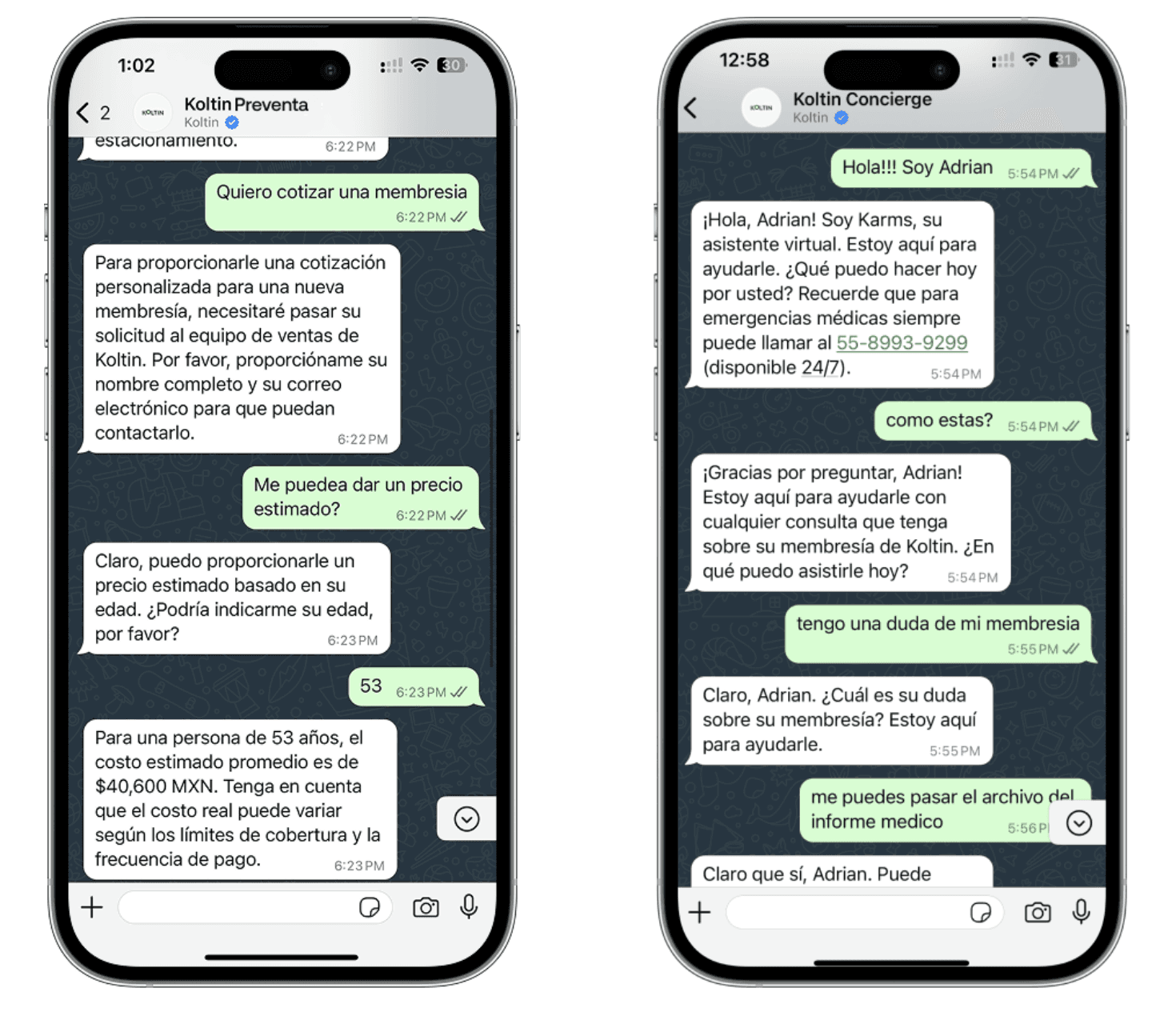
Interact with a Semantiks agent
5. Technology and Innovation
The architecture of the Console combines state-of-the-art language models with custom tools, conversational memory (short and long-term), analytical dashboards, and key integrations such as WhatsApp. This enables the deployment of enterprise-grade conversational agents: fast, secure, and easy to manage. Key technological innovations include:
Agent Orchestration: Advanced use of generative models with specialized techniques to be highly effective, reduce hallucination, and utilize generative AI in many knowledge development and advanced analytics tasks.
Memory and Tools: Short and long-term memory and more than 10 proprietary tools with context retrieval.
Deployment Flexibility: Cloud (default) or on-premise/private models for data-sensitive clients.
Human Validation: Automatic escalation (with full context) to human agents; native integrations with Zendesk, Intercom, Freshdesk, and HubSpot.
Implementation in Minutes: Less than 10 minutes from registration to having a fully functional agent in production.
6. Equipment
The Semantiks team is led by Adrián Sánchez, who brings extensive experience in artificial intelligence and data engineering. He is accompanied by a group of leaders in engineering and business, along with new talent from the top universities in Mexico. We intentionally maintain a small team, but with a high technical density, focused on excellence and innovation. Additionally, several key members of the team are also investors in the project, demonstrating their commitment and trust in the vision of Semantiks.
Adrián Sánchez-Castro — Founder and CEO (full-time)
Former PM at Cohere and Walmart (Conversational AI Platform)José Pablo Barrera — Head of Partner Strategy & Business Development (full-time)
Former PM at Google; leads customer deliveryJake Klein — Head of Data (full-time)
Former Senior Data Scientist at Walmart U.S.Javier De La Torre — Software Engineer (part-time)
Backend and integrations
7. Business Model and Monetization
Target Customers and Monetization Model
Sematiks has segmented types of customers into four levels based on their monthly usage:
Tier 1: 1,000 customer service interactions per month
Tier 2: 5,000 customer service interactions per month
Tier 3: 50,000 customer service interactions per month
Tier 4: more than 100,000 customer service interactions per month
Sematiks' strategy is to focus on Tiers 2-4 due to their current volume and growth. Here’s a description of these types of customers:
Tier 2 and 3 - Mid Scale (5,000 - 50,000 conversions/month): Series A-C e-commerce startups (retail) or fintechs that already manage thousands of inquiries across different platforms and want to automate without developing their own Artificial Intelligence solutions.
Tier 4 - High Volume (≈ 100,000 conversations/month): established retailers, telecoms, banks, and marketplaces that seek to drastically reduce expenditure on Business Process Outsourcing (BPO) (customer service companies), improve user experience, and do not have the resources to develop their own Artificial Intelligence solutions.
Our Pricing
Our costs are aligned solely with agent interactions. No binding contracts or additional costs per user.
Conversation initiated: USD $0.50 (10 min. window)
Tool call: USD $0.20 (integrates CRM, ERP, validations, etc.)
Annual plans with minimum consumption and "shared savings" clauses for enterprise contracts
Unit Economics by Customer Level
*Calculations based on active pilots and contracts; Tier 4 assumes volume discounts (approximately 10%), annual churn less than 10% in a revenue model.
8. Financial Projections
These projections reflect a staggered expansion, ranging from technology startups to established companies with a high volume of conversation and potential for deep integration. The details of this projection can be found here.
9. Financing and Investment Request
Reason for the round
The consulting projects developed in partnership with Google have funded our operations and allowed us to connect with numerous clients to validate market demand. However, to activate recurring subscription revenues, we need external capital. After two years of self-funding and product validation, Semantiks is launching its SaaS platform and seeking investment to:
Convert certain members of the core technical team to full-time and retain top-tier talent.
Build an agile go-to-market function to convert pilots into paying subscribers.
Cover cloud costs and models during the transition to recurring revenue.
We are looking to expand the Friends & Family round with an additional USD 433,000 (post-money SAFE of USD 16 million). This capital will give us 12 months of runway to convert the key team to full-time, fund an aggressive go-to-market strategy, and cover the infrastructure needed to scale the SaaS platform. With these resources, we project to reach operational break-even in Q1 2026, driven by a MRR of USD 83,000.
Round
Amount
Objective
Use of Funds
Round
Monthly Amount
Approximate
Round goal: MXN 8,293,000 (~USD 433,000)
10. Key Milestones
11. Risks and Mitigation Strategies
12. About the Investment
In 2023, we welcomed our first investors—friends, family, and Rarebreed VC—who together invested USD 217,000 through a SAFE at a post-money valuation of USD 16 million. That initial capital funded experimentation with technology, the development of our console, and the validation of our initial use cases.
Today, we are inviting those early believers—along with some new ones—to increase their participation through an additional round of USD 433,000, offered at the same valuation of USD 16 million.
*If interest exceeds five new commitments, we will structure the investment through a Special Purpose Vehicle (SPV) to keep the capitalization table simple.
To learn more about SAFEs and SPVs: https://chatgpt.com/share/683a5b49-1c1c-800b-ac8a-415839ccc19d
Reference for Startup Capital Valuation in AI: https://www.linkedin.com/posts/peterjameswalker_ai-valuations-activity-7293716782979129344--lX0/
Contact
Adrián Sánchez-Castro — Founder and CEO
Email: adrian@semantiks.ai
Schedule a call: https://calendar.notion.so/meet/adrian-/secret-meeting
José Pablo Barrera — Head of Partner Strategy & Business Development
Email: josepablo@semantiks.ai
Schedule a call: https://calendar.app.google/bovbB4tY4ciTr7BD7